
Wheels change how much a setup grips, how it sounds and how high the deck sits. Two sets with the same size printed on the bag can still ride very differently.
Reading a wheel's specs
A set of wheels might be sold as "Street, 7.8 × 5 mm, 70D, single bearing". Most brands give the diameter first, then the width, so 8 × 5 mm means 8 mm tall and 5 mm wide. Some, FlatFace and Blistered among them, give the width first, so check which number is labelled as the diameter.
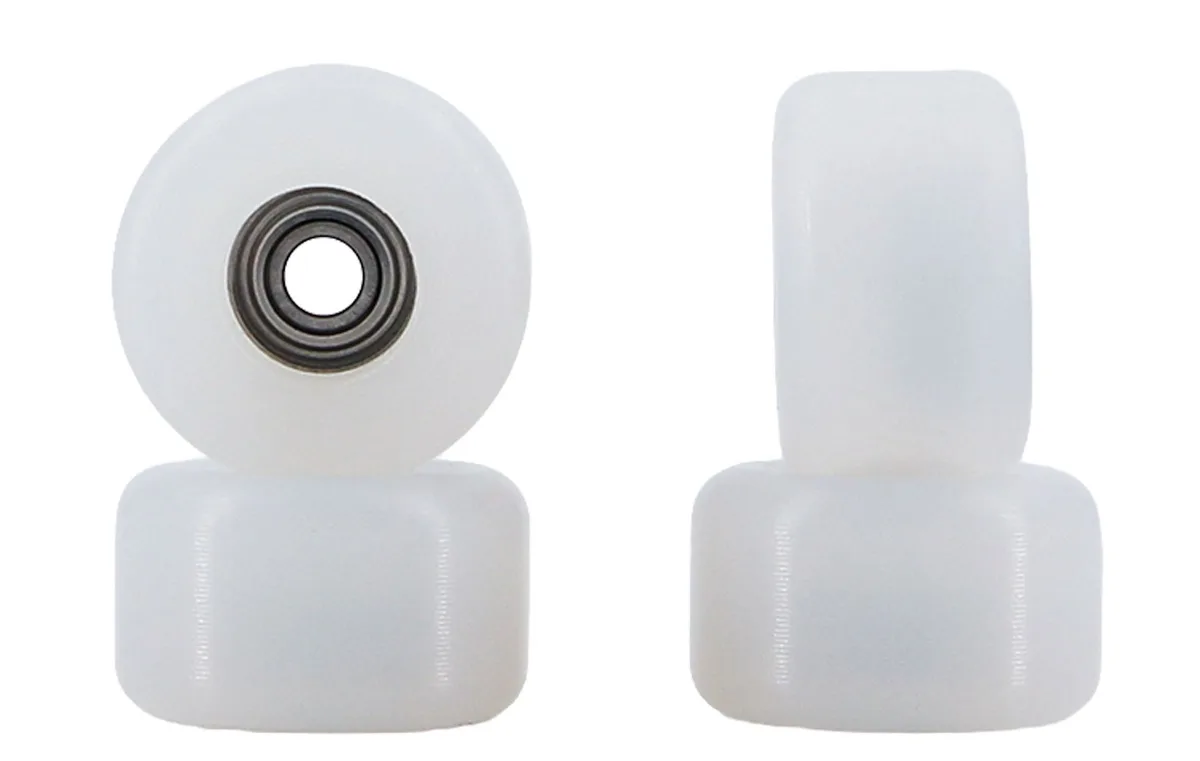
Sunpower High Riderz from the front and from the side: 8.1 mm in diameter, 4.9 mm wide. Photo: Fingerboardstore.
| Spec | What it tells you | Common values |
|---|---|---|
| Diameter | How tall the wheel is, edge to edge | About 6 to 9 mm, most street wheels 7.5 to 8 mm |
| Width | How wide the wheel is across | About 4 to 6 mm |
| Hardness | How hard the material is, on the Shore D scale | Mostly 60D to 72D for urethane |
| Shape | The wheel's profile | Street, conical, radial, tablet, bowl, mini |
| Bearings | How the wheel turns on the axle | Single or dual bearing; basic toy wheels have none |
| Bearing position | Where the bearing sits across the wheel's width | Uncentered (offset toward the truck) or centered |
Plastic or urethane
Toy wheels are plastic, and so are some of the most popular premium wheels. FlatFace, for example, machines its wheels from specialty plastics, and they spin on a bearing. Plastic slides easily, so a landing that's a little crooked still rolls away, and premium plastic wheels last a long time on concrete.
Urethane, short for polyurethane, grips the surface. It squeaks when it holds and resists when you don't turn a trick all the way. Mike Schneider, who runs FlatFace and Blistered, puts it this way: on urethane "you really got to turn your whole trick in the air", where plastic lets you finish the rotation on the ground.
If you like sliding out of tricks and doing reverts, plastic is worth trying. If you want more grip, try urethane.
You'll also see wheels described as resin or a urethane and resin mix. Bloob's wheels are resin, and Piro's owner has called its wheels a urethane resin mix, though its shop sells them as urethane. The label alone doesn't tell you how grippy they'll be.
Recycled wheels are cut from full-size skateboard wheels, so they're urethane too. They can be very grippy and quiet, depending on the wheel they're made from. That grip can also catch when you land a little crooked, especially on wood.
Hardness
Hardness is given on the Shore D scale: the higher the number, the harder the wheel. Most urethane fingerboard wheels are rated between 60D and 72D, and a few go as soft as 50D or as hard as 77D. At Blistered, for example, the 60D formula is the soft, grippy one and the 72D feels closer to plastic. A few wheels are rated on the Shore A scale instead, such as Dudeguy's 3D-printed TPU wheels at 95A, and some recycled wheels are listed with the A rating of the skateboard wheel they came from. There's no exact way to convert an A number into a D number.
Compare durometers within one brand, not across brands. The urethane formula, how the wheel was made and how its surface is finished all change the grip, so two 70D wheels from different makers can feel nothing alike.
Size and shape
| Size | Diameter | Notes |
|---|---|---|
| Mini | About 6 to 7 mm | Sits low, keeps a tall truck from feeling too high |
| Street | About 7.5 to 8 mm | The usual size |
| Bowl | About 8.5 to 9 mm | Sits higher. Some makers' bowl wheels are 8 mm or smaller |
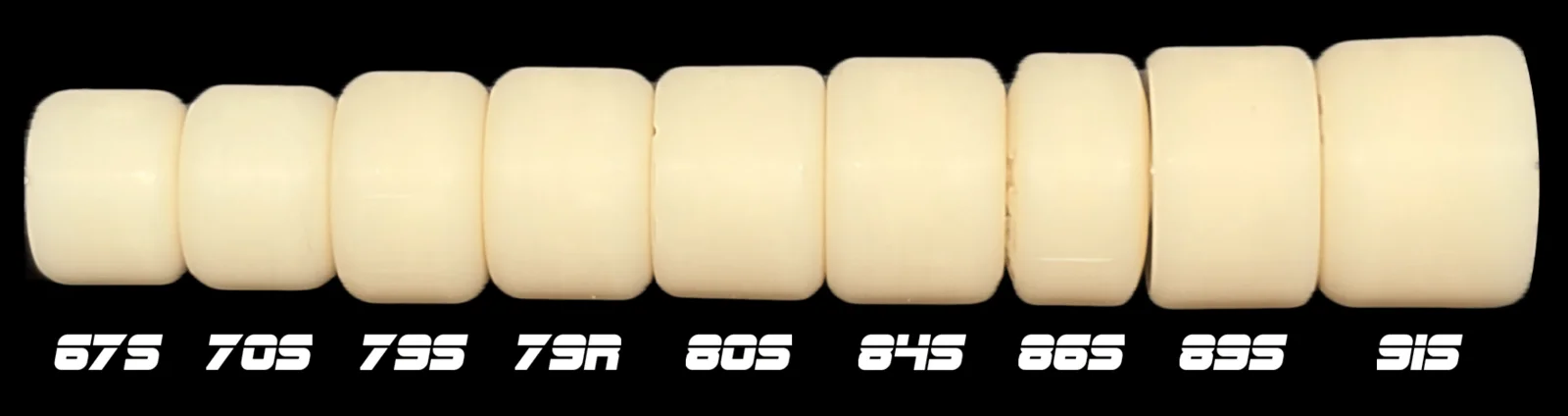
Bloob's wheels side by side. Each one is named after its diameter: the 67s are 6.7 mm tall, the 89s 8.9 mm. Image: Bloob.
A bigger wheel lifts the deck and leaves less clearance between the wheel and the underside of the deck. That makes it more likely to touch when you lean into a turn. A wide wheel on a narrow truck can stick out past the edge of the deck.
Street wheels usually have a fairly flat riding surface. Other shapes have a rounder profile or a sloped face. Shape names vary between makers, so check the photos and dimensions as well as the name.
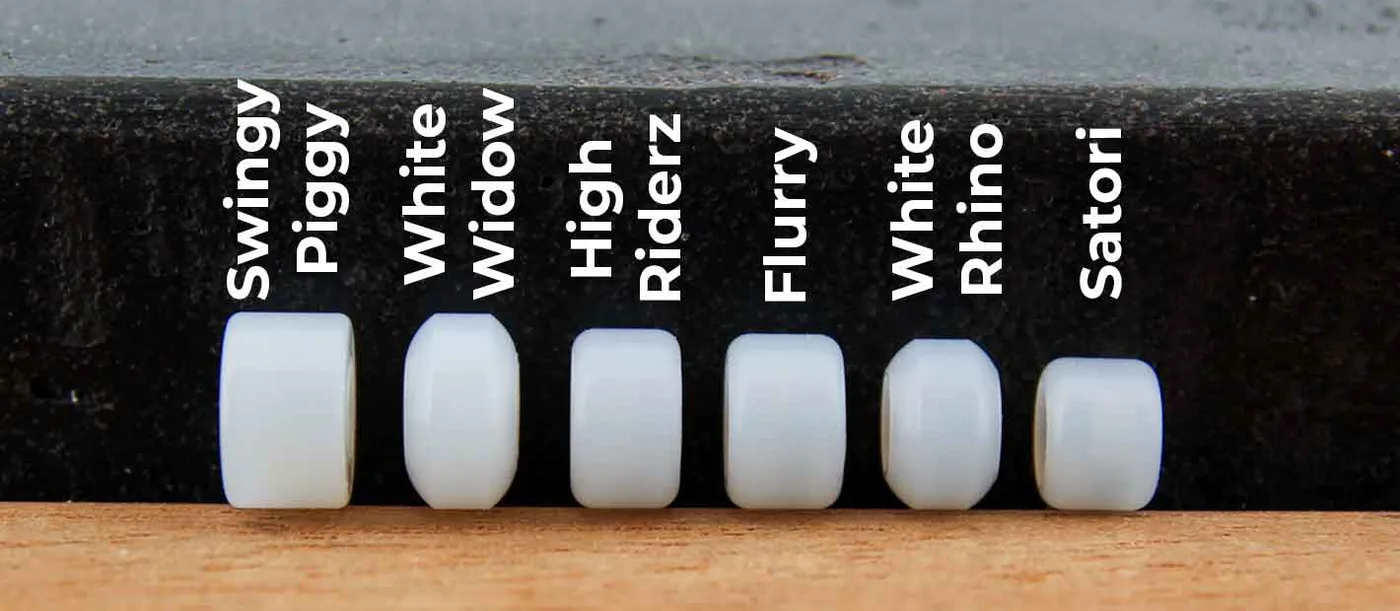
Six Sunpower shapes. Swingy Piggy and White Widow are both 8.8 mm tall, but White Widow is narrower and has sloped edges. Satori is a mini wheel at 6.9 mm. Photo: Fingerboardstore.
Bearings
Basic toy wheels, like the ones on a standard Tech Deck, spin straight on the axle. Most other wheels have a small bearing pressed into the hub, so they roll smoother and more quietly.
Single or dual bearing
Most wheels have one bearing, held in place by a locking shape inside the wheel called the bearing lock.
Dual bearing wheels have two, one on each side, like a skateboard wheel. They need compatible trucks with longer axles. Blackriver and Dynamic both make dual bearing editions of their trucks. Mike Schneider, who makes FlatFace's dual bearing wheels, prefers their feel, but check that the wheels fit your trucks before buying a set.
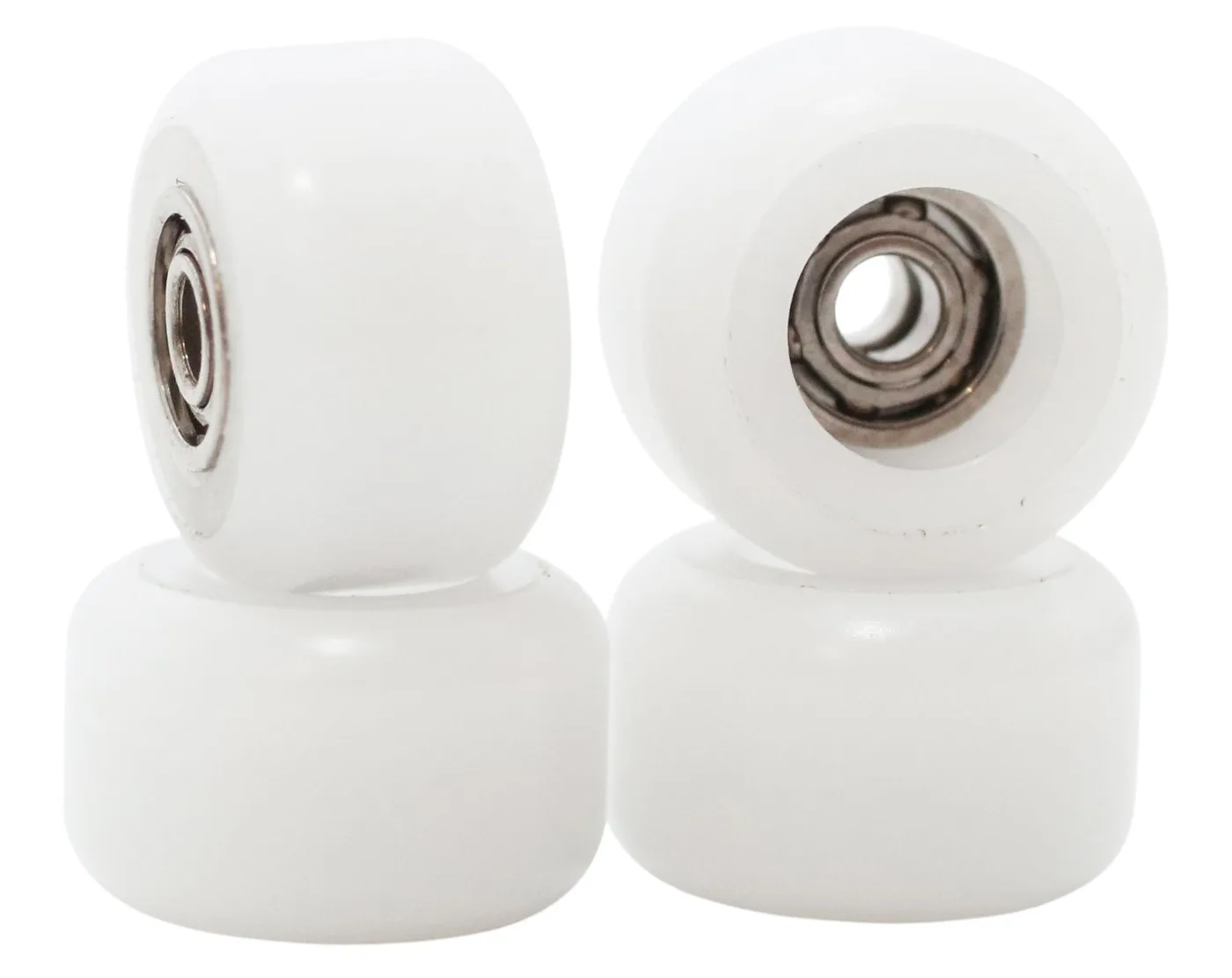
FlatFace dual bearing wheels, with a bearing pressed into each side. Photo: FlatFace.
Bearing position
Where the bearing sits across the wheel's width affects how far the wheel sticks out from the truck. On an uncentered wheel, which makers also call offset, the bearing sits toward the truck side, so the wheel starts about where the hanger ends and hides the locknut. On a centered wheel the bearing is in the middle, so the wheel reaches in over the hanger and more of the locknut shows. Uncentered is the usual choice, and some makers, like Caramel, offer both.
Two sets with the same width can sit differently on the same trucks, so wheel width alone won't tell you whether they'll line up with the edge of your deck. Some makers say where their wheels sit: Bloob lists its 79s as flush with the locknut, and its wider 80s as sticking out about 0.5 mm past it.
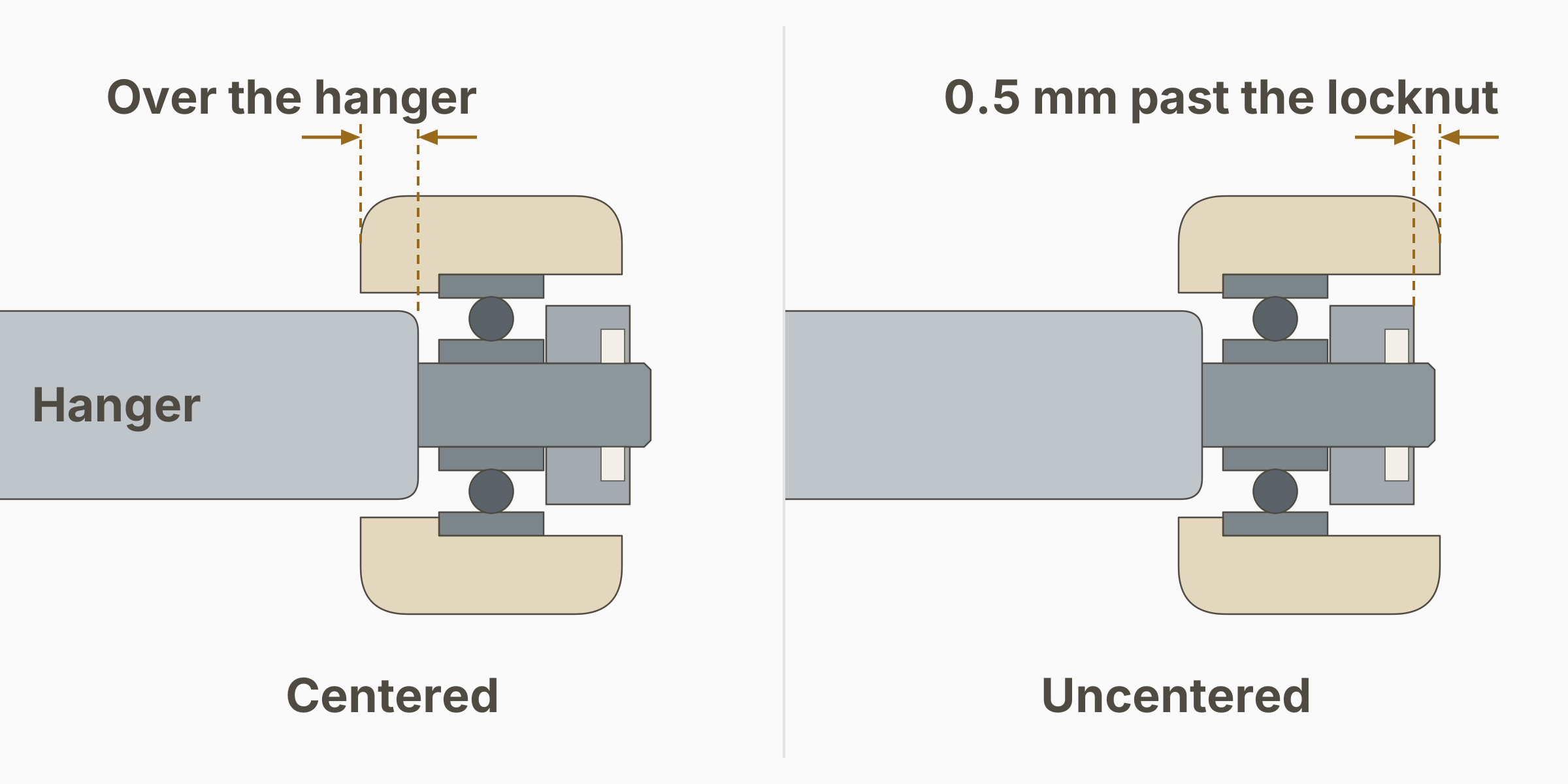
Scroll sideways to see the full illustration.
The same 8 × 5 mm wheel on the same truck, cut in half. Only the bearing's position inside the wheel changes.
Bearing slip
Over time, the bearing in a single bearing wheel can work loose. This is called bearing slip: the wheel starts to rub, stops spinning or comes off the bearing. Makers disagree about which materials slip most. Mike Schneider has seen it on FlatFace's softest plastic, while Ůreth says urethane holds a bearing better than harder materials.
Once a bearing has come out, the lock is often damaged, and pushing the bearing back in may not hold.
Free spin and ABEC ratings
Long free spin doesn't mean a good bearing. A wheel that keeps spinning on its own for ages is often just dry, and dry bearings wear faster. You push the board with your fingers anyway, so a wheel that turns smoothly and evenly matters more.
The ABEC rating printed on some bags doesn't tell you much either. ABEC is a manufacturing tolerance standard, but bags often print a grade without naming who made the bearing, so the number can't be checked.
Choosing wheels for where you ride
| Where you ride | What usually works | Why |
|---|---|---|
| A desk or smooth wood | Anything, urethane if you like grip | Most wheels behave well on a smooth surface |
| Unsealed wood ramps | Plastic or hard urethane | Grippy wood and a grippy wheel catch on reverts and 180s |
| Granite, marble or sealed stone | Urethane, if you want grip | Stone is smooth, so urethane's grip rarely catches |
| Concrete outdoors | Plastic or hard urethane | Rough ground makes soft urethane grip even more |
| Bowls and ramps | Bowl wheels if you like a taller setup | Larger wheels raise the deck |
| Late at night | Recycled or soft urethane | Soft wheels roll quietly, though urethane can squeak on slides |
Fitting wheels to your trucks
A wheel won't spin once it's on. A dual bearing wheel on a standard axle stops turning once the nut is tight, because the axle is too short. It needs a dual bearing truck.
Wheels keep coming off. Locknuts have a nylon ring inside that grips the thread. Once it wears out, the nut keeps spinning and the wheel works loose. Replace the nut.
Wheelbite. This is when a wheel touches the deck as you lean into a turn. Big wheels, loose trucks and low trucks all make it more likely. Add riser pads, tighten the trucks or go down a wheel size. You can also leave it alone: it happens on a skateboard too.
Cleaning
Wheels pick up dust and hair, urethane most of all. Roll each wheel across a strip of tape, sticky side up, or roll the board in circles on a clean sheet of paper.
Few makers publish cleaning instructions, so ask the maker before using alcohol or another solvent. Some people clean their bearings with alcohol, then add a little skate bearing lubricant.
Leave the bearings in place unless the maker says they're removable. Pulling them out can damage the bearing lock. If the maker recommends a solvent clean, follow its directions and let the wheels dry completely before lubricating the bearings with a small amount of light bearing oil.
Skip WD-40 as a bearing lubricant. If a wheel still feels rough or clicks after cleaning, the bearing may need replacing. Ask the maker about a repair or a replacement wheel.
Wheel brands
Browse the wheel brands page for more makers. A few examples:
- Plastic: FlatFace, Blackriver, Sunpower, Cartwheels
- Urethane: Blistered, Piro, Oak, Maple, Joycult, Dynamic, Caramel, Teak Tuning, Clairvoyant, Pip-Squeak
- Resin: Bloob
- Recycled: Dudeguy, Ůreth, Junk Wheels
The spacing between your trucks matters too: see wheelbase in the deck geometry guide.
Corrections welcome. If something here doesn't match what you're seeing in the real world, get in touch on Instagram or Discord and we'll fix it.